Leading the market with 9 clinical studies
Cerebiome® is the most documented psychobiotic with 9 clinical studies among which the first-ever human clinical study involving healthy stressed adults and probiotic intake.
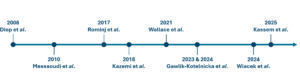
Pioneering clinical studies on a healthy population
Diop 2008: The first study demonstrating the effect of a probiotic on stress-induced gastrointestinal symptoms
75 healthy volunteers (18-60 years old) with at least 2 symptoms of stress were enrolled to take Cerebiome® or placebo for 3 weeks. The study showed a significant reduction of stress-induced gastrointestinal symptoms as assessed by 62 criteria.
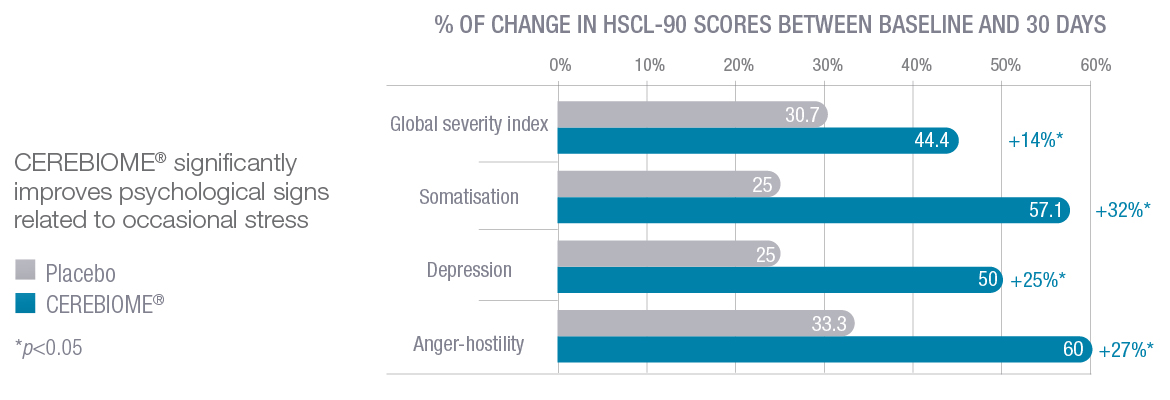
Messaoudi 2010: The first study that demonstrated the positive impact of a probiotic on occasional stress in healthy humans.
This gold-standard study (randomized, placebo-controlled, and double-blind), was conducted on 55 healthy volunteers (30 – 60 years old) for the intake of Cerebiome® or placebo.
After 30 days of intake, a significant reduction of psychological stress as assessed by HSCL-90 tests (validated questionnaire) was shown in the Cerebiome® group. These results were correlated to the significant decrease of cortisol, a biomarker of stress. In less stressed subjects, significant improvement of PSS score, HADS scores, and anxiety/depression score in HSCL were demonstrated in a post-hoc study [Messaoudi 2011].
Wiacek 2024: Trend toward improvement in sleep quality according to validated PSQI questionnaire
It has been demonstrated that stress could have a significant impact on sleep quality. In 2024, Wiacek et al. conducted a randomized double blind pilot clinical study in 15 healthy dancers who tend to have psychological and physical stress. They took either Cerebiome® or placebo for 12 weeks. The results demonstrated a trend toward an improvement of sleep quality according to PSQI validated questionnaire.
First clinical study on gut-brain-skin axis
Kassem 2025: First significant data on stress-related skin conditions, in healthy adults
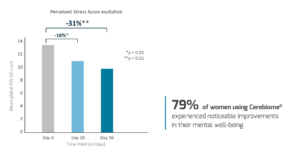
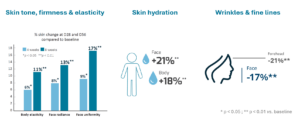
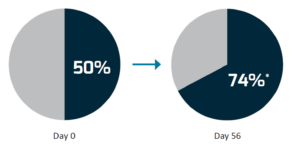
An open-label study evaluated the effect of Cerebiome® on stress and skin health in young French women. After 8-week oral Cerebiome® supplementation, the results showed significant improvement in perceived stress level, sleep quality and skin health which were evaluated by validated questionnaires and under the supervision of a dermatologist. Through the self-evaluation questionnaire, 91% of women reported to be satisfied with the global performance of Cerebiome®. The data supported benefits of Cerebiome® in holistic wellbeing.
- Improvement in perceived stress
- Improvement in skin appearance
- Improvement in sleep quality
Significant improvement in the overall proportion of women who were able to fall asleep or stay asleep during bedtimea.
Significant reduction in the total proportion of women having difficulty staying awake during their normal waking hoursb.
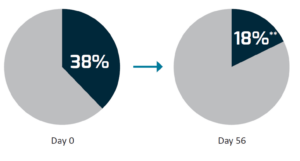
a: “How often do you have trouble going to sleep or staying asleep?” Combining “Rarely” and “Never” answers.
b: “How often do you find it difficult to stay awake during your normal waking hours when you want to?” Combining “All of the time”,“Most of the time” and “Sometimes” answers.
*p < 0.05 **p < 0.01
Pioneering clinical studies on depressed participants
Rominj 2017: Depressed participants without ongoing treatment
This was the first study conducted with Cerebiome® on depressed participants. This gold-standard study demonstrated that Cerebiome® significantly decreased dry mouth and sleep disruption (p<0.05) compared to the placebo group.
Kazemi 2018: Depressed participants with ongoing treatment (for at least 3 months)
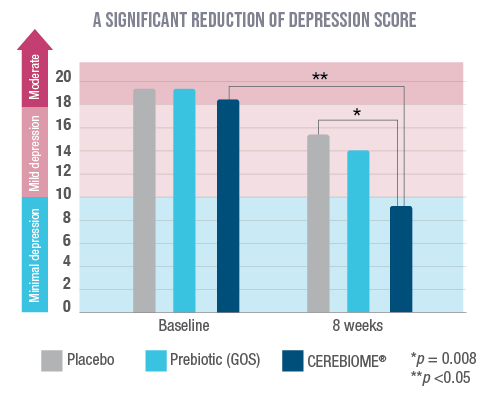
This randomized, double-blind, and placebo-controlled study included 110 patients suffering from mild to moderate depression that were receiving antidepressant treatment.
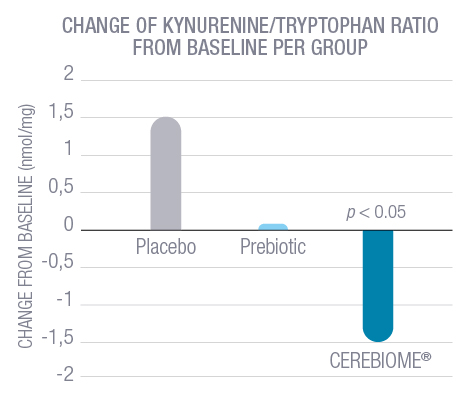
The probiotic was used as an adjunct therapy to conventional antidepressant treatment and showed a significant decrease in Beck Depression Inventory (BDI) scores, from 18 down to 9 on average. These results are clinically significant, showing that the patients, after treatment with Cerebiome®, were now categorized with “minimal depression” according to the validated assessment scale. Additionally, the Cerebiome® group showed a decrease in the blood kynurenine/tryptophan ratio, which suggests that tryptophan was diverted toward the synthesis of serotonin and away from the inflammatory pathway (p<0.05).
Wallace 2021: Depressive participants – treatment naïve
An open-label study by Wallace and Milev found that in treatment-naïve patients, Cerebiome® had a positive effect on mood, anxiety, anhedonia, sleep quality and perceived stress, lasting up to eight weeks after psychobiotic intake.