Cerebiome® mechanisms of action on the microbiota-gut-brain axis
Cerebiome® positively influences the microbiome-gut-brain axis through various mechanisms, leading to mental well-being improvement. Clinical studies have shown its benefits in reducing occasional stress and improvement of related conditions, such as gut comfort, sleep quality but also skin appearance, in healthy individuals. Additionally, eleven preclinical studies have demonstrated its positive impact on anxiety and depression-related behaviors in animal models.
These groundbreaking studies have enhanced our understanding of how Cerebiome® works through eight modes of actions, collectively highlighting the multifaceted approach of Cerebiome in promoting mental and gut health, with promising implications for overall well-being.
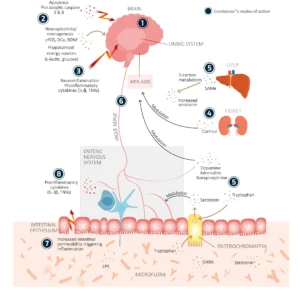
1. Positive impact on behavior
In rodent models, Cerebiome significantly decreases depression-like behaviors. This is evidenced by the normalization of burying time, a marker associated with anxiety, and the restoration of social interaction time with other rats. Additionally, improvements in swimming and learning times have been observed. Recently, findings demonstrated a decreasing in sleep latency and increasing average of REM duration per bouts during sleep phase which are associated with a modulation in sleep architecture in sleep-disrupted adolescent mice [Messaoudi et al. 2010, Arseneault-Bréard et al. 2012, Gilbert et al. 2012, Murack et al.2024].
2. Protection of a healthy brain structure and metabolism
Cerebiome helps maintain normal levels of neuroplasticity and neurosynthesis, crucial processes for brain health. Biomarkers such as caspase and BDNF or hippocampal energy sources such as glucose and L-lactate indicate its positive impact on these aspects [Girard et al. 2009, Gilbert et al. 2012, Malick et al . 2015, Ait-Belgnaoui et al. 2014, Mohammadi et al. 2018, Murack et al. 2024].
3. Prevention of neuroinflammation
Occasional neuroinflammation in the limbic system, a brain region linked to stress response, is mitigated by Cerebiome [Mohammadi et al. 2018].
4. Modulation of the hypothalamus-pituitary adrenal Axis
Cerebiome helps maintain healthy cortisol levels, a key hormone linked to stress, in both humans and animals [Messaoudi et al. 2010, Ait-Belgnaoui et al. 2014, 2018; Malick et al. 2015]..
5. Synthesis of neurotransmitters and their precursors
This probiotic formula normalizes blood neurotransmitters levels in rats and increases neurotransmitter precursors in both rats and humans. Even more, it restores serotonin level and its precursor tryptophan in sleep-disrupted mice. [Tillman et al. 2018, Kazemi et al. 2018, De Oliveira et al. 2023, Murack et al. 2024]
6. Modulation through the vagus nerve
The probiotic formula decreases apoptosis, the naturally occurring cell death process during growth. This mechanism relies on an intact vagus nerve. [Malick et al. 2015]
7. Protection of the intestinal barrier/decreased visceral pain
Cerebiome showed a reduction in intestinal permeability in rats’ model and a decreasing in visceral pain in mice, promoting gut comfort. [Arseneault-Bréard et al. 2012 & Ait-Belgnaoui et al. 2018]
8. Cytokine modulation
Cerebiome showed a reduction of pro inflammatory biomarkers induced by stress, as evidenced by biomarker assessments such as cytokine IL-1β and TNF-α. [Malick et al. 2015, Arseneault-Bréard et al. 2012, Mohammadi et al. 2018]